Sunday, 6 February 2011

Atmospheric Space

Analysing the footage

I have started to think more about my proposal and what I am going to do next. I am really interested in the empty spaces within the footage I have been looking at. I have become interested in and how the space is used within the shot and also how the viewer interprets the narrative of the space around the scenes. The empty spaces have started to become my characters. It is the experience of how the space makes you feel which is what I find interesting. I am going to start to try and use these spaces to show characters through my evidence that I collect. Sound and lighting and key elements to entice you into the scene. It is the significance of the space that makes you want to unravel the crime scene.

How do you experience the space within each shot?

The creation of atmospheric space is very important to my project to portray a filmic setting. It is these images, which are loaded with anticipation, which I am interested in to create a narrative. The emptiness allows you to not get distracted from the story within. Lighting is a fundamental characteristic in creating atmospheric space. The light draws the viewer into the interior of the room. Everyone’s experience of the space is different. No characters within shot add a surreal dream like world, like a scene from a Freddy Kruger nightmare.

How can spaces tell stories?

By using my evidence as visual entities, I will start to create a story within the viewer’s imagination. It is this object that draws the viewer into the space. The unknown story is what fascinates me, as you don’t know what is going to happen next. The absence of people leaves the entire story to the viewer, from what the person looks like, to what the crime committed was. It is as if you are in the crime scene as the investigator, trying to piece together what has gone on.

Saturday, 29 January 2011

Thomas Demand

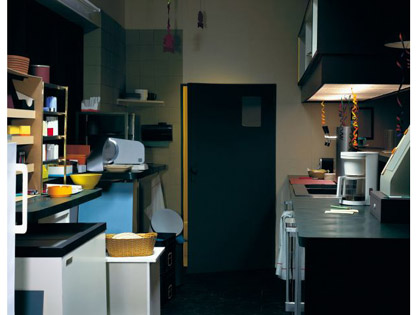
Thomas Demand is known for making photographs of three-dimensional models that look like real images of rooms and other spaces. Demand began his career as a sculptor. In 1993, he began to use photography to record his elaborate, life-sized paper-and-cardboard constructions of environments and interior spaces, and soon started to create constructions for the sole purpose of photographing them. The photograph he takes of this model is the final stage of his work, and it is only this image that is exhibited, not the models. On the contrary, Demand destroys his “life-size environments" after he has photographed them. The subjects represented in Demand’s photographs often relate to pre-existing press images showing scenes of cultural or political relevance. Because he is working from models, the absence of people in his photographs is conspicuous and thematic.

I love the absence of people in Demands models, they look like the creation of film sets.
These sets and images are similar to the type of work that I am creating; empty haunting scenes where the viewing gets enticed into. I like how the viewer can create their own narrative by walking around the space of the scene through their own imaginary.


Split Screen

'In film and video production, split screen is the visible division of the screen, traditionally in half, but also in several simultaneous images, rupturing the illusion that the screen's frame is a seamless view of reality, similar to that of the human eye. There may or may not be an explicit borderline.

Until the arrival of digital technology in the early 1990s, a split screen was accomplished by using an optical printer to combine two or more actions filmed separately by copying them onto the same negative, called the composite.'


Requiem for a Dream has been a constant influence throughout my research so far:

http://www.youtube.com/watch?v=lmBSgu-bMsk


24 is a show that uses split screens extensively :

http://www.youtube.com/watch?v=3ycUmavblmA

Carrie - split screen

One of the first films I ever watched which I always remember for its split screen is Carrie, I aways loved the end scene and like the different views that are used to show what she is looking at and what she is doing.


Final Cut Pro - Split Screen

To build up my technical competence I have started to experiment with final cut pro to try and build up a split screen narrative using the digitilised footage which I have been transfering from VHS.


VHS - DIGITAL

I have now started to analyse my CCTV footage and filter through to find the best scenes and anything that I find interesting or unusual looking characters. I have spent the week in the editing suite transferring my VHS tapes to digital so that I can then go into final cut pro and start to edit the footage and piece it together in a linear and non linear narrative. Thinking forwards to a project proposal I would like to continue to look at the spatial qualities of the fragmented narratives and also look at the narrative of the space around the screens that I want my film work shown on. The interpretation of how we interact with the film is what I find really interesting and I like the idea of a multi screen or/and multi narrative with the use of split screens.


Saturday, 22 January 2011

Edited Stills


This is a stop motion I have made from different stills from the same CCTV camera to create a more linear motion film.
A HD version can be seen on my Vineo.